Federal immigration agents’ role at Minneapolis protests raises questions about crowd-control training, oversight, and safety risks
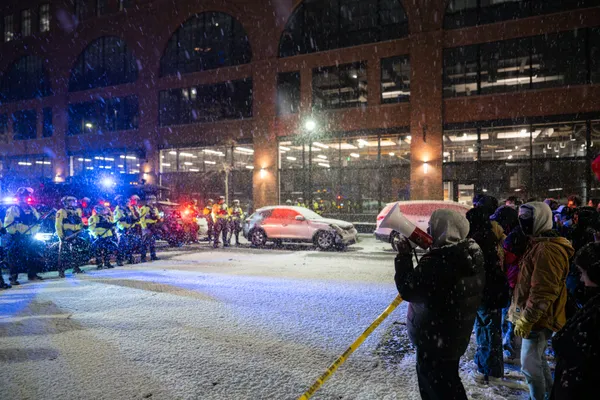
Federal agents move into public-order policing role amid Twin Cities unrest
Federal immigration personnel deployed to the Minneapolis–St. Paul area as part of a Department of Homeland Security operation have increasingly taken on crowd-control and protest-policing functions, a role that local police departments more typically fill. The shift has unfolded alongside heightened demonstrations following the fatal shooting of 37-year-old Renée Good on Jan. 7, 2026, during a federal immigration enforcement action.
Videos from recent confrontations in Minneapolis show federal officers using tactics that include pointing long guns toward demonstrators, deploying chemical irritants, breaking vehicle windows, and forcibly pulling people from cars during close-range encounters. Federal officials have said aggressive measures have been used in response to threats and violence directed at officers. Civil-rights advocates and policing specialists counter that such actions can intensify volatility when applied to crowds rather than targeted arrests.
Experts cite structural differences between immigration enforcement and protest management
Public-order policing relies heavily on planning, communication, and proportional responses that reduce the chance of escalation. Specialists in crowd management note that, across the United States, protest policing practices vary widely and there is no single national standard adopted uniformly by all agencies. Even so, many local departments have built public-order units and protocols that emphasize coordination with event organizers, setting clear boundaries, and limiting force options in dense crowds.
Immigration enforcement personnel, by contrast, are primarily trained and deployed for investigations, apprehensions, detention operations, and removals. Policing scholars say that when officers without extensive experience in crowd dynamics are placed in confrontation-heavy protest settings, the risk of misjudgments rises—particularly with chemical agents, firearms display, and vehicle stops in tense environments.
Training claims, accountability questions, and a widening legal fight
DHS leadership has pointed to federal training pipelines and prior law enforcement experience among recruits, describing preparation that includes de-escalation and conflict management. Critics respond that classroom instruction and basic skills training do not necessarily translate into effective management of fast-changing protest conditions, especially when agencies lack longstanding relationships with the communities where they are operating.
The legal dispute escalated in mid-January. A federal judge in Minneapolis issued a temporary order restricting DHS agents from arresting peaceful protesters who are observing or demonstrating, unless there is suspicion of criminal activity or obstruction. The ruling was framed around the potential chilling effect on First Amendment activity.
Separately, on Jan. 12, 2026, Minnesota’s attorney general—joined by the cities of Minneapolis and St. Paul—filed a federal lawsuit seeking to halt the DHS deployment and limit enforcement practices in the region. The suit alleges constitutional and administrative-law violations and cites impacts on daily life, including strain on local emergency response and policing resources.
Key issues now shaping the public debate
- Whether federal immigration personnel should be used for routine protest policing in major cities.
- What crowd-control training and written policies apply to federal units operating during demonstrations.
- How accountability systems function when multiple federal components operate alongside local agencies.
- How courts will balance federal enforcement authority with constitutional protections for speech and assembly.
The core dispute is not only about enforcement outcomes, but about the rules, training, and oversight governing federal force in public demonstrations.
As protests continue, the court orders and ongoing litigation are likely to determine how federal officers operate in Minneapolis streets—and whether the current model becomes a template for future responses in other U.S. cities.