Indigenous-led Mutual Aid Along Franklin Avenue Emerges as Minneapolis Responds to Intensified Federal Immigration Enforcement
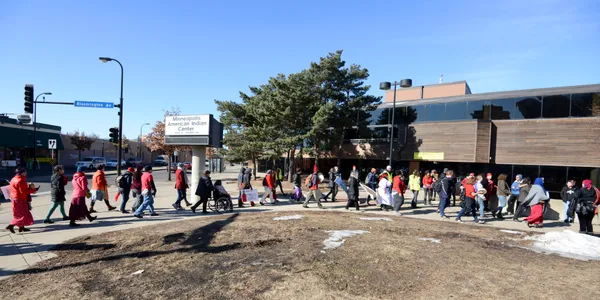
Indigenous community institutions become logistics hubs amid heightened enforcement climate
In recent weeks, Indigenous-led organizations and gathering places in south Minneapolis have expanded their roles beyond cultural programming, shifting into rapid-response mutual aid as federal immigration enforcement activity has intensified across the Twin Cities.
Franklin Avenue—widely recognized as the center of Minneapolis’ American Indian Cultural Corridor—has been one focal point of that organizing. Pow Wow Grounds, a Native-owned coffee shop operating since 2010 near the corridor’s core, has served as a meeting place for community members and a point for distributing basic supplies. The site shares space with Native American Community Development Institute (NACDI) programs, including All My Relations Arts, and sits within a dense network of Indigenous community services along and near Franklin Avenue.
Fear-driven changes in daily routines and public space
On-the-ground reporting from late January described a city where everyday routines were disrupted: some businesses restricted entry, and neighborhood residents took steps intended to improve situational awareness when federal agents were nearby. These adjustments were described as responses to a climate of uncertainty and fear among residents—particularly those concerned about enforcement actions in public spaces.
Parallel to Indigenous organizing efforts, broader mutual aid networks across Minneapolis and St. Paul have mobilized to support families avoiding grocery stores and public food shelves. Volunteer-driven distribution has increasingly emphasized home delivery and discreet coordination, reflecting concerns that visible public services can become harder to access when enforcement activity increases.
Key dates: two fatal shootings during protests and enforcement activity
The organizing has unfolded against the backdrop of two widely reported fatal shootings involving federal immigration enforcement personnel in Minneapolis in January 2026.
Jan. 7, 2026: Renée Nicole Macklin Good, 37, was fatally shot in Minneapolis by an ICE officer. The incident drew immediate public attention and intensified scrutiny of enforcement tactics.
Jan. 24, 2026: Alex Jeffrey Pretti, 37, was shot and killed on Nicollet Avenue by Customs and Border Protection agents during protests connected to immigration enforcement activity. Public demonstrations at the site followed within hours.
Franklin Avenue’s Indigenous institutions have long functioned as community anchors; in recent weeks, residents and organizers have described them as essential for communication, supply distribution, and coordinated support.
Local infrastructure and historical organizing capacity
Minneapolis’ Native community infrastructure includes long-established institutions such as the Minneapolis American Indian Center, founded in 1975, and housing communities such as Little Earth in the Phillips neighborhood. The city is also historically significant to Indigenous activism: the American Indian Movement was founded in Minneapolis in 1968.
Organizers and community members involved in current mutual aid efforts have emphasized practical goals—keeping families supplied, reducing risk in public spaces, and maintaining reliable communication channels. The scale and persistence of the response reflects both the immediacy of recent events and the presence of established Indigenous-led institutions capable of rapid coordination.
What to watch next
As federal enforcement operations and related legal challenges continue to evolve, community-based responses are likely to remain shaped by three factors: the level of visible enforcement activity, the degree to which public institutions such as schools and service providers can operate without disruption, and the capacity of mutual aid networks to sustain delivery-based support for affected families.