Minneapolis police reform under Chief Brian O’Hara faces strain as federal ICE surge escalates tensions
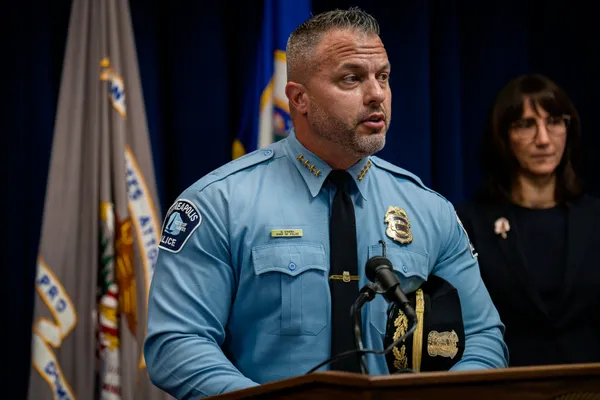
Federal immigration enforcement tests a department still rebuilding after Floyd-era crisis
Minneapolis Police Chief Brian O’Hara, appointed in 2022, has spent the past three years trying to stabilize a department weakened by resignations, low morale and diminished public trust after George Floyd’s murder in May 2020. That effort is now being tested by a large federal immigration enforcement deployment that has triggered protests, emergency calls and intensifying debate over the role of local police amid federal operations.
Beginning in December 2025, the federal government launched what Minnesota officials have called “Operation Metro Surge,” sending thousands of Department of Homeland Security personnel — including Immigration and Customs Enforcement and Customs and Border Protection — into the Twin Cities area. Minneapolis officials say the scale of the deployment has driven public-safety demands that the city must absorb, including crowd control and responses to incidents linked to federal activity.
Shots fired during enforcement operations sharpen scrutiny
The operation has been overshadowed by fatal shootings involving federal agents. On Jan. 7, 2026, Renée Good was killed in Minneapolis during an immigration enforcement encounter. On Jan. 24, 2026, Alex Pretti was fatally shot in Minneapolis during a confrontation involving CBP personnel. The deaths intensified scrutiny of federal tactics and accountability mechanisms, while adding pressure on local authorities to manage community safety and public reaction.
Minneapolis’ policing environment remains defined by competing demands: restoring legitimacy through stricter standards and oversight, while responding to rapidly evolving public-safety pressures tied to federal operations.
Consent-decree reform continues under state oversight, with federal oversight in flux
Minneapolis is operating under a court-enforceable reform agreement with the Minnesota Department of Human Rights, reached March 31, 2023 and approved by a court on July 13, 2023. The agreement requires broad changes aimed at addressing race-based policing, backed by independent monitoring and public reporting.
In parallel, the U.S. Department of Justice announced a consent decree agreement with Minneapolis on Jan. 6, 2025, after federal investigators found a pattern or practice of unconstitutional policing. In May 2025, a federal judge dismissed the federal consent-decree case after the Justice Department sought dismissal; Minneapolis leadership said the city would continue implementing reforms through local action, including an executive order signed June 10, 2025 to codify and accelerate reform measures.
City and state turn to courts over the federal deployment
On Jan. 12, 2026, Minnesota Attorney General Keith Ellison, joined by Minneapolis and St. Paul, filed a federal lawsuit seeking to halt the DHS deployment and requesting emergency relief. State officials later reported that a preliminary injunction request was denied on Jan. 31, 2026, though the court acknowledged substantial claimed harms from the ongoing surge.
- Local leaders have argued the federal operation is consuming police resources through spillover calls and protest-related demands.
- Federal actions in public spaces have increased the volume and urgency of 911 calls that require triage by Minneapolis police.
- Reform commitments remain active under state monitoring, even as federal court oversight is no longer in place.
Within the city, the immediate challenge for MPD leadership is balancing operational capacity, reform obligations and community expectations in an environment where the most consequential enforcement actions are increasingly driven by federal agencies operating alongside — but not under — local command.